The Good Person of Szechwan
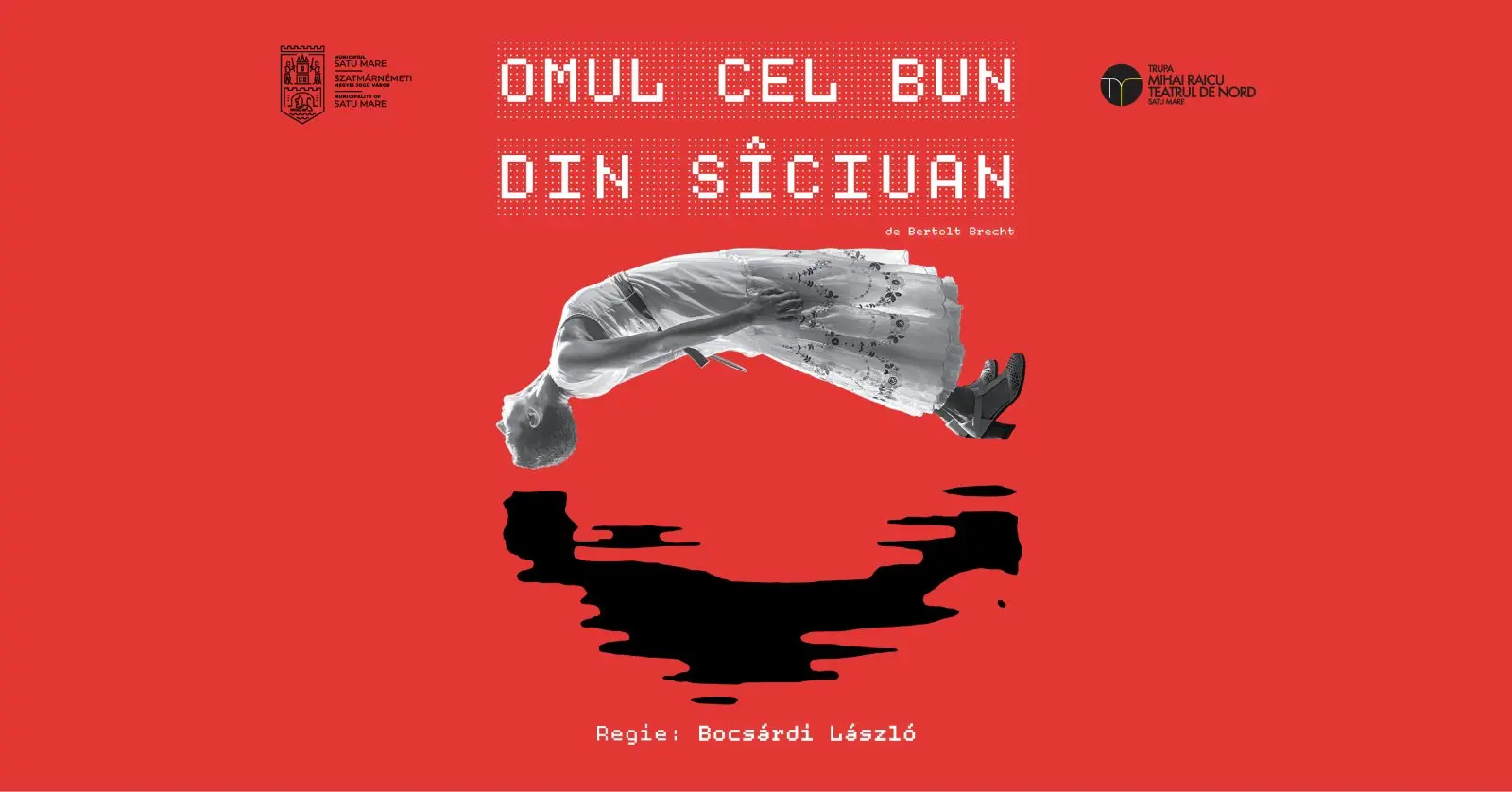
THE GOOD PERSON OF SZECHWAN by Bertolt Brecht
The Good Person of Szechwan took place on Sunday, 18 October 2026, from 19:00, at Teatrul de Nord - Sala Mare (Satu Mare).
About the event
by Bertolt Brecht
Artistic direction: Bocsárdi László
THE GOOD PERSON OF SZECHWAN by Bertolt Brecht
Based on a translation by Mihaela Bogza, Nicoleta Ciupercescu and I.C. Mătăsaru
Stage version: Dálnoky Réka, Bocsárdi László and Ovidiu Caița
֍ ֍ ֍ ֍
Director: Bocsárdi László
Set design: Bartha József
Costumes: Szőke Zsuzsi
Dramaturgy: Dálnoky Réka
Original music: Bakk-Dávid László
Choreography: Bezsán Noémi
֍ ֍ ֍ ֍
Lighting design: Bányai Tamás
Video design: Takács Ádám, Süveg Károly
Assistant director: Tudor Dreve
Costume assistant: Mihály Sára Katalin
֍ ֍ ֍ ֍
Cast:
Shen Te: Georgiana Ghergu
Wang: Romul Moruțan
Sun: Andrei Stan
First God: Ciprian Vultur
Second God: Vlad Mureșan
Third God: Tudor Dreve
Shu Fu: Cătălin Mareș
Mrs Yang: Ioana Cheregi
The Landlady: Alina Negrău
Mrs Shin: Raluca Mara
The Policeman: Andrei Gîjulete
The Woman: Carmen Frățilă
The Man: Radu Botar
The Sister-in-law: Roxana Fânață
The Carpenter: Sergiu Tăbăcaru
The Unemployed Man: Bianco Erdei
The Grandfather: Tibor Székely
The Old Man: Carol Erdös
The Old Woman: Pusztai Judit
The Boy: Ștefan Mureșan
֍ ֍ ֍ ֍
Stage manager: Botos Enikő
Prompter: Yvette Princz
Sound: Gabi Feleg
Video projections: Rareș Uglean
Lighting: Ioan Iluță, Călin Mocan
֍ ֍ ֍ ֍
Genre: a tale with an improbably happy ending
Running time: 2 h 30 min (with an interval)
Recommended age: 14+
The performance uses smoke and sound effects that may affect sensitive people.
֍ ֍ ֍ ֍
There is great poverty in Szechwan, and people say only the gods can still help. Three of the greatest gods appear in the city. For two thousand years there have been rumours that a person cannot stay good on this earth. It is decreed that this world will perish if the three gods do not find at least one good person. But nobody is willing to take the gods in, not even for one night. Nobody except Shen Te. Will this young woman, who makes her living by selling herself to men, turn out to be the good person who can save the world? And how much will her goodness cost her?
֍ ֍ ֍ ֍
"For Brecht, theatre, the most social of the arts, must become a microcosm of society as a whole, where the most important questions of political philosophy are debated and 'symbolic and utopian allegories' of social structures and relations are created. His friend, the philosopher Walter Benjamin, aptly described the new relationship between audience and performers that Brechtian theatre involves: for its audience, the stage is no longer 'the boards that represent the world' (in other words, a magic circle), but a pleasant space of public exhibition. For its stage, the audience is no longer a collection of test subjects for hypnosis exercises, but a collective of interested people whose demands must be met. Brecht's theatre work was devoted to creating and refining the rules and techniques of this laboratory for investigating human relations, in order to understand them as scientifically and thoroughly as possible, so that they could then be improved or changed completely. Brecht was convinced that such an undertaking required new aesthetic means. He experimented all his life to discover them, usually together with artistic collectives: through rehearsals and performances, reviews and poems, public speeches and aesthetic polemics, learning plays and philosophical dialogues. These attempts and experiments gradually crystallised into an original method of practising political theatre, and Brecht became one of the most influential theatre makers of the 20th century. Perhaps only the writings of Konstantin Sergeyevich Stanislavski and those of Antonin Artaud have had a comparable impact. Brecht's influence, however, is broader and reaches beyond theatre: his theories and method are a subject of study, inspiration and debate in fields as diverse as cinema, Marxist political philosophy, feminist studies, advertising and game design." (David Schwartz)
֍ ֍ ֍ ֍
Bertolt Brecht (1898–1956) was a poet, playwright and reformer of German theatre, one of the major figures of 20th-century European theatre. His work radically transformed the theatrical conventions of his time, putting at the centre of theatre the relationship between the individual and society, the mechanisms of power, social inequality and individual responsibility.
Born in Augsburg, Brecht studied medicine in Munich and, during the First World War, worked in a military hospital. His first plays, among them Baal and Drums in the Night, appeared in the 1920s, a period in which he developed a deeply critical attitude towards bourgeois values and towards a society struggling with the devastating consequences of the war. In Berlin, from 1924, he worked with major figures of German theatre such as Max Reinhardt and Erwin Piscator, and with the composer Kurt Weill, with whom he created The Threepenny Opera and Rise and Fall of the City of Mahagonny.
In this period he shaped the theory of epic theatre, through which Brecht proposed an alternative to a theatre based on emotional identification and stage illusion. Spectators should not forget that they are in a theatre, nor passively accept the world shown on stage as an inevitable reality. On the contrary, they should keep a critical distance from the characters and situations and be encouraged to reflect on their social and historical causes.
The concept of Verfremdungseffekt, translated as the "distancing effect" or "alienation effect", became one of the fundamental principles of Brechtian theatre. Through various stage devices (addressing the audience directly, song, commentary, interrupting the action, exposing the mechanics of theatre or changing perspective), spectators are reminded that they are watching a performance and are invited to look critically at the behaviour and social relations being shown.
Brecht became a Marxist in the late 1920s, and a materialist view of society had an important influence on his playwriting. In 1933, when the Nazis came to power, he was forced into exile. His books were burned in Germany and his citizenship was revoked. He lived in Scandinavia and then in the United States, where he went on to write some of his most important works.
The years of exile were also one of the most productive periods of his career. During this time he wrote Mother Courage and Her Children, Life of Galileo, Mr Puntila and His Man Matti, The Caucasian Chalk Circle and The Good Person of Szechwan. His plays take the form of parables in which individual situations become ways of examining wider social problems: war, exploitation, poverty, responsibility, the relationship between money and power, and how hard it is to remain moral in a system built on inequality.
The Good Person of Szechwan, written in exile, starts from the question of whether a person can remain good in a world where survival often demands compromise and competition. The play's fundamental question is not only whether people can be good, but also in what kind of society goodness could become possible without turning into vulnerability or permanent sacrifice.
In 1949 Brecht returned to Berlin and, together with his wife, the actress Helene Weigel, founded the Berliner Ensemble, which became one of the most important centres of Brechtian theatre. There he developed and applied his aesthetic and political principles by staging his own texts and through continuous research into the relationship between actor, character, stage and spectator.
Brecht died of a heart attack in East Berlin in 1956. His artistic legacy, however, goes beyond the political context in which it was created. His theatre continues to influence contemporary playwriting, directing and theatre teaching through one essential question: can theatre do more than represent the world, and make us look at it critically and ask whether and how it can be changed?
֍ ֍ ֍ ֍
CAST
Georgiana Ghergu
Shen Te
Romul Moruțan
Wang
Andrei Stan
Sun
Ciprian Vultur
First God
Vlad Mureşan
Second God
Tudor Dreve
Third God
Cătălin Mareș
Shu Fu
Ioana Cheregi
Mrs Yang
Alina Negrău
The Landlady
Raluca Mara
Mrs Shin
Andrei Gîjulete
The Policeman
Carmen Frăţilă
The Woman
Radu Botar
The Man
Roxana Fânață
The Sister-in-law
Sergiu Tăbăcaru
The Carpenter
Bianco Erdei
The Unemployed Man
Tibor Székely
The Grandfather
Carol Erdös
The Old Man
CREATIVE TEAM
Bocsárdi László
Artistic direction
Bartha József
Set design
TECHNICAL TEAM
Botos Enikő
Stage manager
Yvette Princz
Prompter
Gabriel Feleg
Sound
Rareș Uglean
Video projections
Călin Mocan
Lighting
Ioan Iluţă
Lighting
Source: Teatrul de Nord Satu Mare - Trupa Mihai Raicu - mihairaicu.ro/g/spectacol/1260/omul-cel-bun-din…
Performed in Romanian with Hungarian surtitles.
Information and tickets: theatre box office, 6 Horea Street, tel. 0261 712 106 / 0786 538 580.
Want to hear about more like this?
Every Thursday we email you the weekend events in Satu Mare and the county. Free, unsubscribe any time.
We first send a confirmation email; your subscription starts only after you click the link in it. Privacy